The year 2026 represents a major period of transition for self-employed passenger transport operators. Between the redefinition of the micro-business thresholds, the tightening of tax regulations and the fast-approaching electronic invoicing revolution, there is no room for improvisation when it comes to managing your accounts. For a driver, Value Added Tax (VAT) should not just be seen as an administrative burden. It's a complex mechanism which, if mastered, can optimise your company's profitability while avoiding the now very heavy penalties. This guide deciphers for you the imperative rules in force this year.
In a nutshell
-
The right rates : The reduced rate of 10 % applies to pure transport (including baggage and tips), while time rentals and ancillary sales are taxed at 20 %.
-
The tax grey zone : In 2026, you will become liable for VAT from €37,500 (with a tolerance currently up to €41,250), but you can retain the simplified social status of a micro-enterprise up to €83,600.
-
The commission trap : Reverse charge of VAT on applications (Uber, Bolt) is a net cost of 20 % if you are exempt, but the administration grants a right to error in the event of an oversight that is rectified spontaneously.
-
The digital shift : E-reporting (the automatic transmission of your income to the tax authorities for private customers) is becoming your new reality, and you need to be ready for it by 2027, or face the threat of heavy fines for the first time.
What VTC 2026 VAT rate should you apply to your services?
Invoicing your customers requires a precise definition of the nature of your service. The tax authorities are very strict about the distinction between passenger transport and vehicle hire.
The reduced rate of 10 % for pure transport This is the norm for most of your journeys. This rate applies when the service is a genuine journey, for which the price is linked to the distance or the final destination is fixed in advance (airport transfer, classic city run). This rate of 10 % also includes all supplements inherent in the transport, such as the handling of bulky luggage or additional passengers. It is important to note that tips paid by customers via payment terminals (TPE) or applications form part of the price of the service and are subject to the same 10 % rate.
The standard rate of 20 % for the provision of services As soon as mileage becomes a secondary criterion and you invoice by the hour, half-day or day (for a wedding or a business client), the service is reclassified for tax purposes as «chauffeur-driven car hire». The rate then changes to 20 % for the entire invoice. The same applies to top-of-the-range ancillary services billed separately (such as the sale of a bottle of champagne on board). If you offer an all-inclusive package, it is compulsory to break down your invoice to apply 10 % to the transport portion and 20 % to the portion for goods consumed.
2026 thresholds: decoupling VAT from micro-enterprises
This is where many drivers make strategic mistakes. In 2026, it is vital to keep your VAT status separate from your social security status with URSSAF.
Basic VAT exemption Under this scheme, you do not have to charge VAT (you invoice exclusive of VAT), but you cannot reclaim it on your purchases. For services, the exemption threshold is €37,500, with a tolerance of €41,250. Contrary to popular belief, this threshold is not recalculated pro rata to the time you have been in business during your first year. On the other hand, if you exceed the €41,250 threshold during the course of the year, you become liable for VAT retroactively from the first day of the month in which you exceeded the threshold.
URSSAF ceiling raised to €83,600 The most dangerous mistake is to link VAT to micro-entrepreneurship. In 2026, the ceiling for retaining micro-entrepreneur status has been raised to €83,600. There is therefore a large «grey zone»: a driver generating €60,000 in sales will invoice with VAT (because he exceeds €41,250) and will reclaim it from his expenses, while remaining under the simplified micro-business regime for his URSSAF social security contributions.
Real plans and the great upheaval of 2027 Once you are liable for VAT, you will be governed by the Simplified Real Estate Regime (Régime Réel Simplifié - RSI) for sales of up to €286,000, which involves two half-yearly instalments and an annual balance sheet. But don't wait too long: the law stipulates that this simplified scheme will be abolished altogether on 1 January 2027. All taxable drivers will be obliged to switch to the Standard Real System, which will mean monthly VAT returns. So it's vital that your accounts are fully digitised.
VAT deduction: vehicles and fuel subtleties
The general principle of French taxation prohibits companies from reclaiming VAT on passenger vehicles. Fortunately, as professionals in the public passenger transport sector, you benefit from an express exemption.
You are entitled to recover 100 % of VAT on the cash, credit or leasing (LOA/LLD) purchase of your vehicle. This benefit extends in full to operating costs: repairs, tyres and professional cleaning. The non-negotiable condition is that the vehicle must be used exclusively for your business. Using it for your personal weekends exposes you to heavy penalties in the event of an audit.
As far as fuel is concerned, the rules are more complex. While electricity and NGV allow a deduction of 100 %, petrol, diesel and Superethanol E85 are capped at 80 %. Why is this? Because on your vehicle registration document, your work tool is still registered as a Passenger Vehicle (PV) and not as a Commercial Vehicle (CV). By way of comparison, the tax authorities have historically favoured taxis, which can reclaim 100 % of VAT on diesel, an exemption that VTCs unfortunately do not enjoy.
Read our article « Deductible VAT: what you can actually reclaim as a VTC driver »Find out everything you need to know about what you can and can't get back!
Platforms and reverse charge: managing foreign invoices
Working with giant matchmaking companies (based in the Netherlands or Estonia) generates intra-Community financial flows. These platforms invoice you for their commissions exclusive of tax, and it is up to you, the French professional customer, to reverse-charge the transaction by declaring the French VAT on 20 %.
If you are liable for VAT, the operation is neutral (you declare and deduct the same amount). But if you are exempt from VAT (micro-entrepreneur under €37,500), you cannot deduct anything. You therefore have to pay this 20 % of VAT to the State on each commission, which directly reduces your margin.
Failure to make this declaration is punishable by law by a fine of 5 % of the sums due. However, the tax authorities accept a policy of benevolence: the «right to make a mistake». If you realise that you have forgotten to file a tax return, you can file an amended return on your own initiative, before the tax authorities issue any formal notice, in order to be exempt from this penalty.
Billing 2026-2027: the era of e-invoicing and e-reporting
Forget the simple Word or PDF invoice. The timetable for electronic invoicing is now clear: from September 2026, you will need to be able to receive electronic invoices, and in September 2027, the rules for issuing them will change radically.
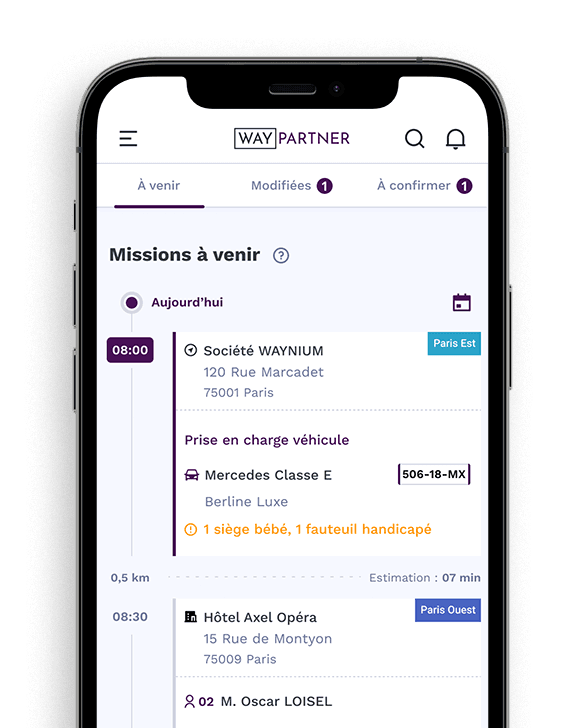
It is vital to distinguish between two obligations depending on your customer base: For your professional customers (B2B, companies, concierge services), you must issue a structured electronic invoice (the e-invoicing) via a government-approved platform. But most of your business is with private customers (B2C). For these races, you will be subject to the e-reporting. This means that you will be obliged to automatically and regularly electronically transmit your transaction data (turnover, VAT amounts) to the tax authorities. This is precisely where specialised business software such as WAY-Partner becomes essential, so that you can automate these flows without spending your nights doing it.
Massive new financial sanctions The Finance Act for 2026 has introduced an unprecedented arsenal of penalties. Persisting in sending old PDFs to a business customer after September 2027 will cost you a fine of €50 per invoice. Worse still, failing to send your e-reporting (B2C) data is punishable by a fixed fine of €500 per missing transmission, with an overall ceiling of up to €15,000 per year.
The critical point of vehicle resale
The life cycle of your vehicle is under close fiscal scrutiny. If you resell a vehicle on which you have reclaimed VAT at the time of purchase, you must collect VAT (20 %) on the resale price, whether the buyer is a professional or a private individual.
This rule should not be confused with the «fifths» adjustment rule. The latter only applies if the vehicle leaves your company's assets without being subject to VAT (for example, if you close your company and keep the car for personal use for less than 5 years). In this specific case, the government will ask you to repay part of the VAT initially deducted. To optimise your costs, it is often wiser to sell your vehicle to a professional dealer.
Stay rigorous, anticipate the digitisation of your processes, and use the right tools to secure your business.
Glossary
Here are some useful terms to know and understand:
-
Reverse charge : A tax mechanism whereby it is the business customer (the driver) who calculates, declares and pays the VAT due on a service provided by a foreign company (such as a matchmaking platform).
-
e-invoicing : Issuance, transmission and receipt of an invoice in a structured electronic format (B2B), via a government-approved platform.
-
e-reporting : Obligation to transmit transaction data (receipts, tax amounts) concerning B2C sales to the tax authorities in an automated and dematerialised form.
-
Basic franchise : A tax regime that exempts a company from having to declare and pay VAT on the services it provides, provided it does not exceed certain turnover ceilings.
-
Simplified Real Estate Regime (RSI) : Simplified VAT system involving half-yearly instalments and an annual balance sheet, due to disappear in favour of monthly returns at the beginning of 2027.