The VTC sector in France has seen a decade of intense regulation, and 2026 is no exception. At the heart of this system is a document that is often seen as a mere administrative formality, but which is in fact your legal «bullet-proof waistcoat»: the booking voucher.
Far from being insignificant, this document marks the legal boundary between your activity and that of taxis. Without it, you are no longer a private chauffeur on a mission, but a motorist in potential breach of the law. Understanding how it works means protecting your business card, your vehicle and the future of your business.
In a nutshell
- The VTC differs from the taxi in that it is absolutely compulsory to prior booking You are strictly forbidden to engage in any form of marauding (physical or electronic).
- Since 29 October 2025, all reservation forms must include 7 compulsory details standardised by the Order of 6 August 2025.
- Document retention is not limited to 3 years: to protect you commercially and for accounting purposes, archiving for 3 years is essential. 5 to 10 years is recommended.
- If you fail to do so, you risk being reclassified as an illegal marauder: this is an offence punishable by a year's imprisonment and a €15,000 fine.
Maraude vs Reservation: the red line that must not be crossed
In order to operate with peace of mind, we need to go back to the basics of transport law. The market is split in two:
- Le Taxi : They have a monopoly on «marauding», meaning that they can park on the public highway and wait to be hailed by a customer.
- The VTC : It operates exclusively in the «pre-booking» market.
This means that every time you are behind the wheel in the course of your business, you must be able to justify your presence on the road by a firm command received. before care.
The end of the «Electronic Marauding» service»
The ban is not limited to physically seeking out customers. Case law has become stricter, notably with the ruling of the Cour de cassation on 25 June 2025. It has now been confirmed that displaying the geolocation and availability of a vehicle in real time on a map prior to any booking constitutes unfair competition. In concrete terms, the booking form must be generated and the order validated. before you make yourself visible or move towards the customer.
The «Back to Basics» obligation»
It's a fundamental rule (article L. 3122-9 of the French Transport Code): as soon as you drop off a customer, you are obliged to return to your company's headquarters or park in an off-street area (garage, private car park). The only exception? You must be able to prove that you have made a new reservation beforehand. The booking voucher is therefore your only legal «safe-conduct» for staying on the road between assignments.
Anatomy of good compliance: the Order of 6 August 2025
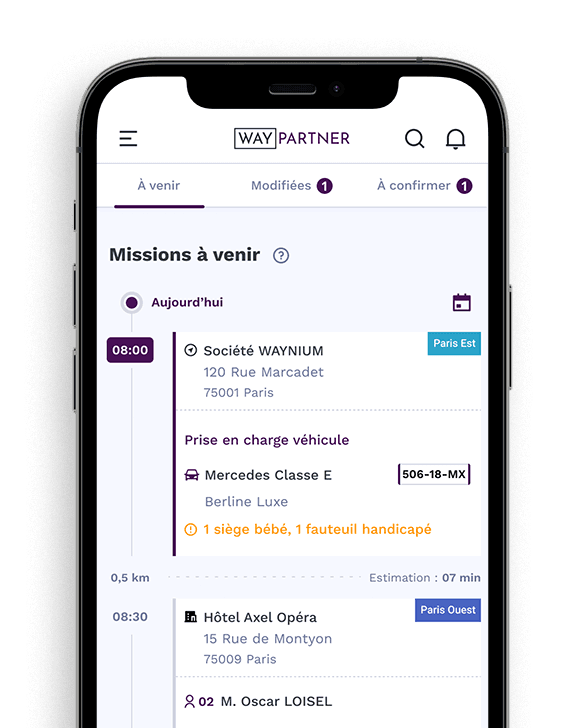
The days of approximate supporting documents are over. The decree of 6 August 2025, which came into force at the end of October, has standardised the format to facilitate checks. To be valid, your voucher (paper or digital) must must contain the following 7 items of information:
- Identity of the operator : Company name and full contact details.
- REVTC number : Your VTC registration number.
- SIREN number : Your unique company identifier.
- Customer details : Name and telephone number.
- Important difference: If this information is masked by a confidentiality application, you must be able to provide law enforcement agencies with an immediate means of contacting the customer.
- Date and time of booking : Proof that the order was placed prior to collection.
- Date and time of pick-up : The scheduled start of the service.
- Place of care : The precise address of the appointment.
Expert advice: Although optional for criminal validity, we strongly recommend that you add the destination and the price incl. VAT. Why should I do this? The booking voucher also serves as tax proof. It proves the nature of the service (passenger transport) and justifies the application of the rate of VAT reduced to 10 % on your turnover, unlike service commissions, which are often taxed at 20 %.
Reality on the ground: day-to-day management and controls
Sometimes there's a gap between theory and reality. Here's how to manage your receipts on a day-to-day basis without putting yourself at risk.
Paper or digital?
The Transport Code authorises both formats. The digital format has become the norm, but beware of the obligation of means: if your battery is flat or your tablet crashes during a check, you are considered to be without supporting documents. Having a pre-filled paper counterfoil booklet (with SIREN, REVTC) in your glove compartment is still an excellent safety measure.
Stations and airports: the zone of vigilance
These are the places where the pressure of the controls (Boers) is strongest.
- Parking : You can only park in the dedicated zones if you have a confirmed reservation.
- The time rule : Your presence is tolerated at most one hour before the pick-up time. Please note that this time is a logistical tolerance for dealing with delays, not a right to wait for an order on site.
Beware of local specificities (e.g. Nice)
Although the law is national, some sites have specific rules. At Nice airport, for example, the red VTC badge is not enough: you need to show a specific access badge («Badge Bleu»). Always check the prefectoral decrees for the areas you frequent, as these badges can represent an additional annual cost that you need to plan for.
Risks, penalties and archiving
Never neglect this document. Failure to provide a booking voucher is not just a minor offence, it can also be a criminal offence.
Criminal and administrative risk
The penalties can be devastating for your business:
- Prison and fine : Up to one year's imprisonment and a €15,000 fine (€75,000 for a company).
- Vehicle : Risk of immobilisation or even permanent confiscation of the vehicle.
- Licence and card : Suspension of driving licence (5 years) and withdrawal of VTC professional licence.
Document retention: get it right!
A common mistake is to think that keeping your vouchers for 3 years is enough. While the tax recovery period is indeed 3 years, the accounting and commercial reality is different. The booking voucher is a commercial and accounting document. To protect yourself in the event of a customer dispute (commercial statute of limitations) or an in-depth accounting audit, we recommend that you keep your vouchers (ideally scanned) for 10 years (legal accounting deadline).
The booking voucher is much more than an administrative constraint: it is proof of your professionalism and a guarantee of your long-term future. At a time when controls are being stepped up in line with the 2026 regulations, rigour is not an option. To free your mind and focus on driving, the ideal solution is to rely on management tools that automate the creation and secure archiving of these compliant documents over the long term.
Glossary
Here are some useful terms to know and understand:
- ADS (Autorisation de Stationnement) : Administrative term for taxis« »licence", giving them the exclusive right to park on the public highway while waiting for customers (marauding).
- Boers : Nickname given to the police officers in the unit specialising in checking taxis and public passenger transport. They are responsible for checking the conformity of your booking vouchers and signage.
- Marauding : The practice of driving or parking on public roads in search of customers. This practice is strictly prohibited for VTCs and constitutes an offence if carried out without prior reservation.
- Maraude Électronique : Using an application to inform nearby customers of its availability and location before a reservation is made.
- RC Pro (Professional Civil Liability) : Compulsory insurance for the carriage of persons for hire or reward, covering damage caused to third parties and passengers in the course of the activity.
- REVTC (Register of VTC Operators) : Official register managed by the Ministry of Transport where all operators must be registered in order to operate legally.
- SIREN : Unique 9-digit identification number allocated to each French company when it is registered. It must appear on the booking form.