The nightmare of any VTC driver is not having the right document to present in the event of an unexpected check by the «Boers» or the traffic police. Between transport regulations, the Consumer Code and tax requirements, it's easy to get lost.
There's a confusion that comes up a lot: «Do I need to get a quote for this errand? The answer is not as simple as a yes or a no. Often, what you call an »estimate« is actually a »booking form«. And legally, that changes everything.
The purpose of this article is to clarify your documentary obligations once and for all, so that you can drive with peace of mind.
In a nutshell
To put it simply:
- The Booking Form is ALWAYS compulsory. This is your proof of mission, which you must have in the event of an inspection (paper or smartphone) to prove that you are not on the prowl.
- A quotation is compulsory in only two cases: if the customer expressly requests it, or if the amount of the service exceeds 1 500 €.
- The Invoice is ALWAYS compulsory once the race is over, regardless of the amount.
The Booking Form: Your daily passport
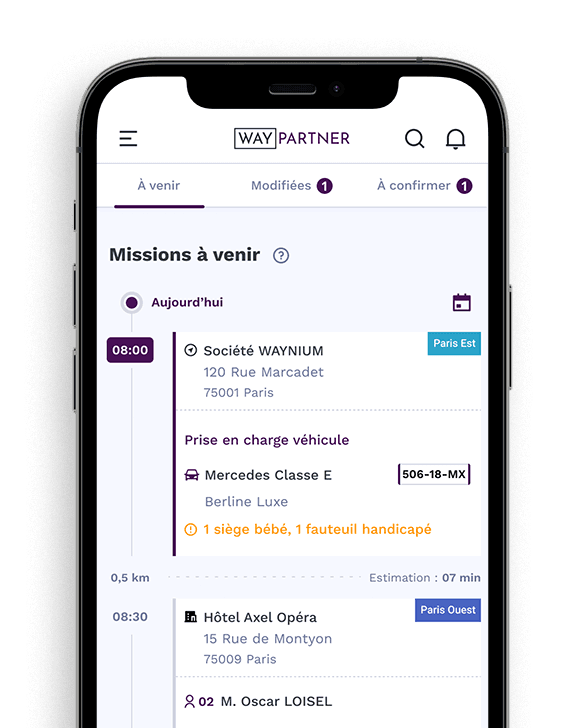
This is the central document for your business. Unlike taxis, which can pick up customers on the fly («marauding»), a VTC can only pick up a passenger if it can show proof of a prior booking.
Absolute legal obligation
According to article L3122-9 of the French Transport Code, you must never have a customer on board (or be on your way to pick them up) without being able to show proof of reservation.
This document is not a quotation in the strict sense of the term. mission order. It serves as proof to the police that you are in fact carrying out a commissioned activity and not illegally seeking customers on the public highway. You must keep it for 3 years.
What it should contain
To be valid during a check, your booking form (paper or digital format on your chauffeur application) must mention :
- Your company : Name, contact details, VTC registration number (EVTC), SIREN.
- The customer: Name and telephone number.
- The mission: Date and time of booking, date and time of pick-up, place of pick-up.
Important note: Although the price is not legally required on the booking form for roadside checks, We strongly recommend that you include it. This turns your booking form into a contract, sealing the agreement on the fare with the customer before the journey.
Specifications: When do they become compulsory?
A quotation is a concept that comes under the consumer law and not the Transport Code. It is a commercial proposal detailing a service and its price. Once signed by the customer, it becomes a contract.
For the vast majority of your daily errands (station transfers, airport transfers, intra-city journeys), you don't need to draw up a formal estimate - the booking form with the price is all you need. However, the law requires a quote in two specific cases.
Case 1: The €1,500 threshold
As soon as a service provided to an individual exceeds an amount of 1 500 €, If you are travelling by air, it is compulsory to draw up a written estimate before concluding the contract. This is rarely the case for a simple Paris-Orly journey, but it is common if you are doing Availability (MAD) over several days, events, weddings or long-distance tourist tours.
Case 2: The customer's request
Whatever the amount, if a customer asks you for a quote, you are obliged to provide one. This is a consumer right.
Commercial interest
As well as being an obligation, knowing how to draw up a good estimate is an essential commercial skill. For B2B customers or event organisers, a clear, professional quote is reassuring. This is often what makes the difference between a «chauffeur» and a «transport contractor».
The complete cycle: Quotation, Booking, Invoice
To avoid confusing the documents, you need to visualise the chronology of a VTC assignment. Each document has its place and its role.
Stage 1: The commercial phase (The quotation)
- When? Before the customer says «yes».
- What is it? A costed estimate (especially for provision of services or complex requests).
- Is it compulsory? No, unless > €1,500 or customer request.
Stage 2: The contractual phase (Reservation Form)
- When? As soon as the agreement has been concluded and before taking charge.
- What is it? Proof of order.
- Is it compulsory? YES, always. It's your legal protection on the road. Tools such as driver applications or management software like WAY-Plan generate this document automatically.
Stage 3: The accounting phase (The Invoice)
- When? Once the service has been completed.
- What is it? The official request for payment.
- Is it compulsory? YES, always.
Please note that the invoice must be a separate document from the booking form. It must contain specific information (unique invoice number, due date, late payment penalties, etc.). Above all, it must provide details of the service (departure, arrival, kilometres) to justify the application of the rate of VAT reduced to 10 % specific to passenger transport. Without this detail, a tax inspector could require the vehicle to be reclassified as a 20 % vehicle.
The risks involved
Not complying with these obligations exposes your company to serious risks:
- No Booking Form : If you are stopped by the police, you risk being fined and, more seriously, prosecuted for practising the taxi profession illegally (marauding), which could lead to your vehicle being immobilised or even to the loss of your professional card.
- No quotation (when required) : This is a breach of the Consumer Code. Administrative fines can be as high as €3,000 for an individual and €15,000 for a company.
To sum up, for your daily life as a VTC driver: never leave home without your reservation form. It's your life insurance against problems during a roadside check. Book it now quote for your top-of-the-range services, long-term provisioning or large amounts (over €1,500). Finally, never forget to issue your invoice after each race. Rigorous administrative management is the hallmark of true professionals and protects you in the event of a tax or administrative audit.
Glossary
Here are some useful terms to know and understand:
- Booking form : A compulsory document (paper or digital) for each VTC journey, proving prior booking and containing specific legal information (location, date, contact details).
- Availability (MAD) : Service where the vehicle and its driver are booked for a fixed period (e.g. 4 hours, 1 day) rather than for a journey from point A to point B.
- Marauding : Driving or parking on public roads in search of customers without prior reservation. This practice is prohibited for VTCs and reserved for Taxis.
- Reverse charge : VAT mechanism whereby the business customer declares and pays the tax on behalf of the service provider, often in the case of subcontracting or intra-Community invoicing.