The vast majority of drivers start out on apps. This is normal: access is immediate and the flow of journeys is constant. But making do with them is a strategic mistake. Being 100% % dependent on the platforms means being subject to high commissions and imposed pricing. Real profitability and entrepreneurial freedom lie elsewhere: in developing your own private clientele.
This guide gives you a step-by-step guide to building a solid customer portfolio.
In a nutshell
- Legality : Parking at stations or airports without a reservation is prohibited (this is known as «marauding» and is punishable by a 5th class fine). The "Reservation Voucher" is your only safe-conduct.
-
Profitability : Don't set your prices at random. Use the «binomial method» (fixed + variable costs). Beware of VAT: 10 % for a transfer, 20 % for a provision.
-
Digital : On Google My Business, hide your physical address to avoid suspension of your listing («Service Area Business»).
-
Status : If you want to make a living from your private life, the Micro-entreprise option is reaching its limits (non-deductible charges). The EURL is often the winning structure in 2025.
The Legal Framework: What you (really) have the right to do
The Transport Code is strict. Unlike an artisan plumber, a VTC cannot canvass just anywhere.
The red line: La Maraude
This is trap number 1.
- Physical Marauding : Parking near a station, an airport or a nightclub exit while waiting for a customer is illegal. Without a justified prior reservation, you risk a heavy fine, suspension of your driving licence and immobilisation of your vehicle. Once you have finished your journey, you must return to your «place of establishment» or to a private car park, unless you have already made another reservation.
- Maraude Électronique : Using open applications such as «radar» to signal your presence to customers is also prohibited for freelancers.
The Sesame: The Booking Form
This document is compulsory for all private customers before customer boarding. In the event of a check, you must present a voucher (paper or smartphone) containing :
- Name of operator and customer.
- Date, time of pick-up, place of departure and arrival. Failure to provide this document is a 4th class offence. Don't play with it.
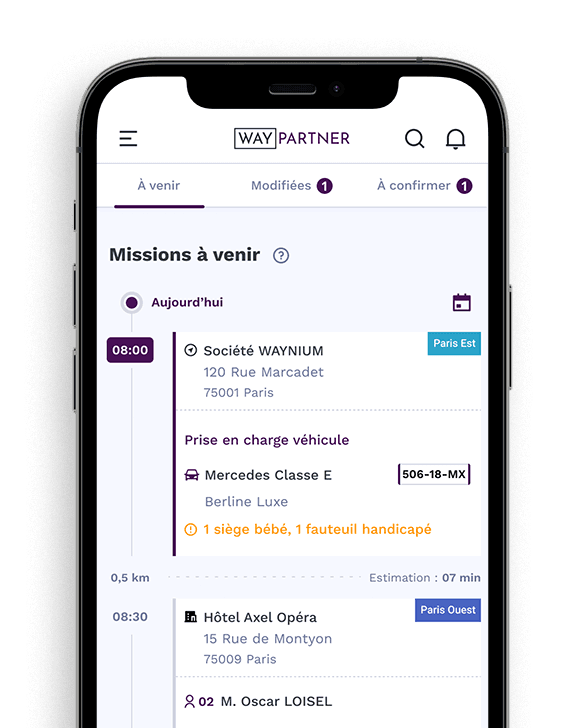
PS: WAY-Partner allows you to generate your vouchers automatically and keep them with you at all times.
B2C vs B2B: The nuances of canvassing
- With passengers (B2C: Business to Consumer): This is a grey area. Giving your card to a passenger for an errand on an application is technically considered as «customer diversion» by the platforms (risk of deactivation). Legally, this is not illegal. if the initiative is passive (response to a customer request). So never be insistent or take the initiative. Always wait for a customer to ask you.
- With companies (B2B: Business to Business): This is a green light. You're perfectly entitled to approach hotels, concierge services or businesses. This is classic B2B commerce. But be careful: never pass yourself off as a Taxi driver.
Changing our stance: the need for independence
Applications should be a springboard, not an end in themselves.
The limits of platforms
Working solely with aggregators poses three major problems:
- Committees: They reduce your sales by 25 % or more.
- The fixed tariff : You have no control over your selling price. It's often dragged down, forcing you to increase volume to get by.
- Precariousness : An account can be deactivated overnight. With no customers of your own, your business comes to a screeching halt.
The right timing
Don't wait until you're too busy to think about your private customers. The best time to prepare your strategy is before to receive your VTC card. Take advantage of the administrative delays to create your website, your business cards and define your targets. Once you're up and running, you won't have much time for sales.
The foundations : Prepare your product
Before making any approaches, make sure your offer is sound.
Impeccable service
Private customers pay more. So they expect more.
- Punctuality : This is the absolute basis.
- Home : Get out of the vehicle, open the door and load the luggage.
- On board: Impeccable vehicle, bottled water, chargers. It's this standard of service that justifies the price difference with a standard journey.
Setting the right price
To be profitable, forget about app prices and make a clear distinction between :
- Fixed charges (Cost per day) : Insurance (professional liability + road traffic, expect to pay ~€250/month), vehicle loan, accountants, software, CFE... Even when your business is at a standstill, it still spends money (often ~€60/working day).
- Variable costs (Cost per km) : Energy, maintenance, tyres, cleaning.
Your net income after tax is generally half your gross margin (Gross Margin = Turnover - Fixed Costs - Variable Costs).
Case in point: If your target is €2,000 net after tax in your pocket, for example, you need to generate around €4,000 in gross margin. This implies a much higher price per kilometre than the platforms.
The VAT pitfalls
Many drivers make mistakes and risk a tax adjustment.
- Transfer (Point A to Point B) : VAT 10 %.
- Available for hire (weddings, shopping, hourly rates) : VAT 20 %. Don't invoice a wedding at 10 % VAT, it's illegal.
Tools and Visibility: Avoiding technical errors
Mandatory tools
To be credible in front of a customer, the vital minimum is :
- Eftpos terminals : Indispensable (in machine or smartphone application). High-end customers no longer pay in cash, and in general you save yourself a lot of hassle by avoiding cash payments.
- Billing : Professional software for issuing estimates and invoices instantly (this is where a tool like WAY-Partner saves you time).
- Business card : Your virtual and physical shop windows.
Tools to speed things up (Further information)
Once the foundations have been laid, these tools will help you to organise your business and develop your image:
- The website: It's your 24-hour shop window. It reassures customers (who will «google» you before booking) and allows you to take bookings while you sleep.
- A connected diary / Dispatch : Forget the notes in the phone. A forgotten errand is fatal for your reputation. Using a comprehensive app like WAY-Partner means you can centralise your schedule, customers and invoices in one place, and avoid double-booking mistakes.
- WhatsApp Business : A large part of the VTC driver's job involves WhatsApp. The Business version is more professional than the WhatsApp Personal version. It allows you to set up automatic greetings and create quick replies to send your fares in two clicks.
Google My Business: Beware of suspension
The Google listing is vital for local referencing. But Google is on the hunt for VTCs that display a physical address (home) even though they don't receive any customers. The solution: Configure your listing as a «Service Area Business» and hide your exact address. Otherwise, you risk a «Hard Suspension» (total disappearance of the listing).
The Website : The niche strategy
A «VTC Paris» site will be useless, it will drown in the mass. Aim for the «long tail» (specific queries). Create dedicated pages: «Van Beauvais Disney Shuttle», «Private chauffeur baby seat Lyon». That's where the profitable customers who are looking for a specific service are. Integrate a booking module that gives a fixed price. Private customers hate the uncertainty of the meter.
Attracting private customers (B2C)
This is the first step in diversifying your income.
Digital visibility: Google My Business
This is your main weapon. Create a Google business listing. It's free and puts you on the map when a customer is looking for a driver in your town. The secret: Reviews. Systematically solicit your satisfied customers. A listing with 50 positive reviews will always be ahead of the competition.
Canvassing in the field
Target local influencers: hotels, B&Bs, gourmet restaurants. Don't present yourself as a lone freelancer. Say «I represent a transport company». This reassures receptionists, who need to be reliable for their customers.
Please note: marauding is strictly forbidden in VTCs.
Natural conversion
All the platforms formally prohibit the active diversion of customers (i.e. advertising during the journey).
However, you remain an independent service provider. If the quality of your service prompts a customer to ask whether you have a business card or whether you take private bookings for future trips, you are perfectly entitled to answer in the affirmative and hand over your card.
The difference is crucial: don't solicit, but be ready to respond to demand.
Please note: The aim is never to recover the race in progress (which would be fraud and regularly leads to permanent bans), but to be ready to respond to a customer request for subsequent needs.
Aiming for stability with professionals (B2B)
B2C brings immediate cash, B2B brings security.
Why B2B?
Companies have recurring and planned needs. A single framework contract can provide guaranteed monthly working capital.
Who to target?
Target structures that consume transport and have a budget:
- Law firms and notaries.
- Event agencies.
- Wine Tours.
- Clinics (transport not covered by agreement).
The prospecting method
Forget random door-to-door canvassing. Be methodical:
- LinkedIn : Identify the right contacts (Office Managers, Executive Assistants).
- Telephone : Call to present a structured offer.
- Regularity : Set aside a slot each week for prospecting (e.g. Tuesday morning).
Developing a private customer base in 2025 requires radical professionalisation. The «I drive and I see» model no longer works. You need to become a fleet manager: compliant on documents, precise on taxation, and strategic on marketing. This is the most demanding path, but it's the only one that will protect your future in the face of algorithms.
Glossary
Here are some useful terms to know and understand:
- ZPEC (Zone de Prise en Charge) : Geographical area where the driver is authorised to pick up a customer (by reservation only for VTCs).
-
Reservation form : Compulsory document (paper or digital) justifying the advance order. If it is missing during an inspection, you will be fined.
- TCO (Total Cost of Ownership) : Total cost of vehicle ownership (Purchase + Maintenance + Insurance + Energy).
-
Availability (MAD) : Service where the vehicle is hired by the hour/day without a predefined itinerary (VAT 20%).
-
Boers : Police unit specialising in passenger transport (taxis and VTCs).