The chauffeur-driven passenger transport sector is undergoing major technological and regulatory change. From September 2026 for receiving invoices, and September 2027 for issuing them (for micro-enterprises and VSEs), the way you invoice your business customers (B2B) will change radically with the obligation to switch to electronic invoicing. Added to this will be the obligation to’e-reporting for your private shopping. No more tinkering with Word or sending PDFs by e-mail.
For a self-employed driver, invoicing is no longer a simple administrative formality. It has become the crossroads where legal compliance, tax optimisation and profitability meet. With so many different products on the market, choosing the right tool is a strategic decision. Should you opt for general accounting software or a specific business solution? Here's our detailed analysis to help you decide.
In a nutshell
-
A new regulatory era: Between 2026 and 2027, it will become compulsory to send and receive structured electronic invoices (e-invoicing) and to transmit your turnover data electronically (e-reporting).
-
Strict VTC requirements: A compliant invoice requires you to include information that is very specific to your profession, such as a precise calculation of CO2 emissions or details of your professional indemnity insurance.
-
The limitations of traditional tools : While general accounting software (such as Indy or Abby) is good for pure accounting, it requires time-consuming manual configuration to adapt to the complexity of your business, particularly for VAT reverse charge or gross invoicing.
-
WAY-Partner as a matter of course : This solution is the benchmark for self-employed drivers. The tool natively integrates all these obligations and automates your document management. The precious time you save quickly pays for itself in additional journeys.
VTC invoicing and reform: what really changes for your documents
The reform of electronic invoicing immediately disqualifies rudimentary tools. You will have to use software capable of generating structured data flows (such as the Factur-X format) and managing the’e-reporting for your B2C business. But beyond the computer format, it is the very content of your invoices that is under close scrutiny.
The Transport Code and the General Tax Code impose a veritable arsenal of compulsory information. In addition to your identity and that of your customer, your invoice must reflect the reality of the journey. This includes the places of departure and arrival, the mileage, and above all the calculation of the CO2 emissions generated by the journey, which has become an imperative for ecological transparency. And don't forget the details of your civil liability insurance (RC Pro) and its geographical coverage, required under the Pinel law.
Finally, the question of VAT is a minefield. Many drivers start out on a «basic VAT exemption» basis (they don't charge VAT, but have to enter their VAT number on their invoice). «VAT not applicable, art. 293 B of the General Tax Code».»), but often give up this status in order to reclaim VAT on the purchase or hire of their vehicle. If you are a taxable person, VTC invoicing is subject to a dual rate. A pure transport service from point A to point B benefits from the reduced rate of 10 % (even if you charge a supplement for bulky luggage, because «the accessory follows the principal»). If, on the other hand, you charge an hourly rate, the standard rate of 20 % applies. Your software should be able to handle this subtlety without you having to think about it at the end of each trip.
Comparison of invoicing software for self-employed drivers
The market can be divided into two main categories: business software designed for transport, and horizontal accounting tools. Here's how they stack up against your real needs.
WAY-Partner: The all-in-one solution for self-employed VTC drivers
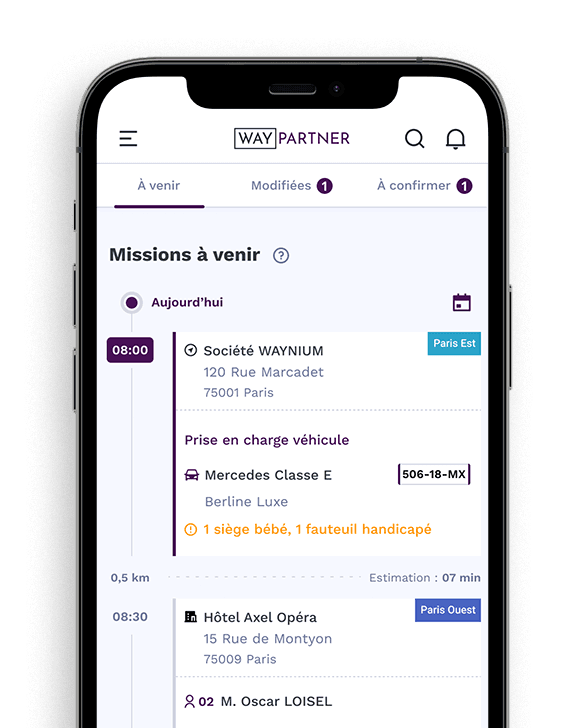
If you're looking for absolute peace of mind, WAY-Partner is the solution that ticks all the boxes. Unlike the generalists, the application has been developed specifically for the constraints of the self-employed driver. All the compulsory VTC information is natively integrated. For example, the software automatically calculates CO2 emissions based on the distance and your vehicle, so you don't have to.
But the real strength of WAY-Partner lies in its ecosystem. The tool connects you directly to the Waynium network, giving you access to an exchange of journeys between drivers. This is a business development feature that no other invoicing software offers. Admittedly, the tool represents an investment, but the gain in administrative productivity is such that it frees up precious time for you to make new journeys, making the solution very profitable.
General accounting software: Indy, Abby, Tiime
These platforms are proving very popular, particularly with micro-entrepreneurs and freelancers. Tools such as Indy and Abby excel in accounting automation via bank synchronisation. They often offer free invoicing and affordable subscriptions for remote tax transmission. Tiime, on the other hand, is already well advanced in e-invoicing compliance.
However, their great strength is also their weakness for your profession: they know nothing about the VTC business. CO2 management, obligations relating to professional liability insurance and the intelligent switch between the VAT rates of 10 % and 20 % are not included as standard. It's up to you to create your own templates and set the parameters for each legal detail manually. This is a significant risk of error when you're invoicing between two car park runs.
Other Business Solutions: Updrive and Evolvir
There are other alternatives designed for transport. Updrive, for example, is a highly agile mobile application. Like WAY-Partner, it incorporates a profitability calculator based on the Cost Per Kilometre (CPK) to tell you immediately whether a journey is profitable. It's an excellent basic financial management tool, but offers less functional depth than WAY-Partner for the overall development of your private clientele (access to the exchange, partner circles, etc.).
The main selling point of Evolvir, which costs €39 per month, is its website creation module coupled with a booking system. It enables drivers to quickly set up a digital shop window to make it easier to take orders. However, while this is a very interesting feature, the software remains fairly simple when it comes to managing the business itself and strict document management.
4 costly billing errors for VTC drivers
Even with the best software, some human errors when issuing invoices can result in heavy penalties in the event of a tax audit.
- Continue to invoice using Word or Excel : The use of a simple spreadsheet is already risky, but with the 2026-2027 reform, it will become totally illegal. The tax authorities are imposing a fine of 50 % of the amount of the transaction for the use of tools that allow invoices to be modified after the event (which is tantamount to concealing revenue).
- Forget the specific information for VTCs : If you forget to include the CO2 calculation or your professional indemnity insurance, you will be fined 15 euros for each missing item. Although this fine is legally capped at 25 % of the invoice amount, its accumulation in the event of an inspection can be very damaging to your cash flow.
- The net amount and VAT trap with VTC platforms (Uber, Bolt, etc...): Many drivers make the mistake of declaring the net amount paid by the application. However, you must always invoice the gross amount paid by the customer. Worse still, as the platforms are often based abroad (the Netherlands, Estonia), you yourself have to calculate and pay the VAT of 20 % on their commission to the French State: this is the principle of reverse charge of intra-Community VAT.
- The wrong VAT rate: The rule of «the accessory follows the main» is not well known. A supplement for bulky baggage is still taxed at 10 % like transport. The standard rate of 20 % should be strictly reserved for time-based invoicing (availability), where the customer buys your availability rather than a simple journey.
Glossary
Here are some useful terms to know and understand:
- B2B (Business to Business) : All commercial relations between two companies or professionals.
- Factur-X : Mixed electronic invoice format (human-readable in PDF and machine-readable via structured data) that will become the standard.
- PDP (Partner Dematerialisation Platform) : Private service provider registered with the tax authorities, responsible for transmitting electronic invoices between companies and the State.
- PPF (Public Billing Portal) : Government platform for the free exchange of electronic invoices.